Date and time
Friday 6 November 2026 at 9:30 am AEDT
Ends Friday 6 November 2026 at 10:30 am AEDT
Location and format
Online
Online · National
About this event
It is a scenario family lawyers regularly encounter in one form or another.
A client has worked in their spouse's or former partner's business for years. Their income comes from the business. Their former partner controls the company. Their employment may be informal, intertwined with their role in the family, or structured in a way the client has never really questioned.
Then they separate.
Suddenly, access to the workplace or business systems is removed. Hours or salary are reduced. Employment is terminated. Accrued entitlements become an issue. Or the client is told that they were never really an employee at all.
For the family lawyer, the immediate instinct may be to address the problem through the family law proceedings. But the same facts can give rise to an entirely separate set of employment law rights, remedies and strategic considerations.
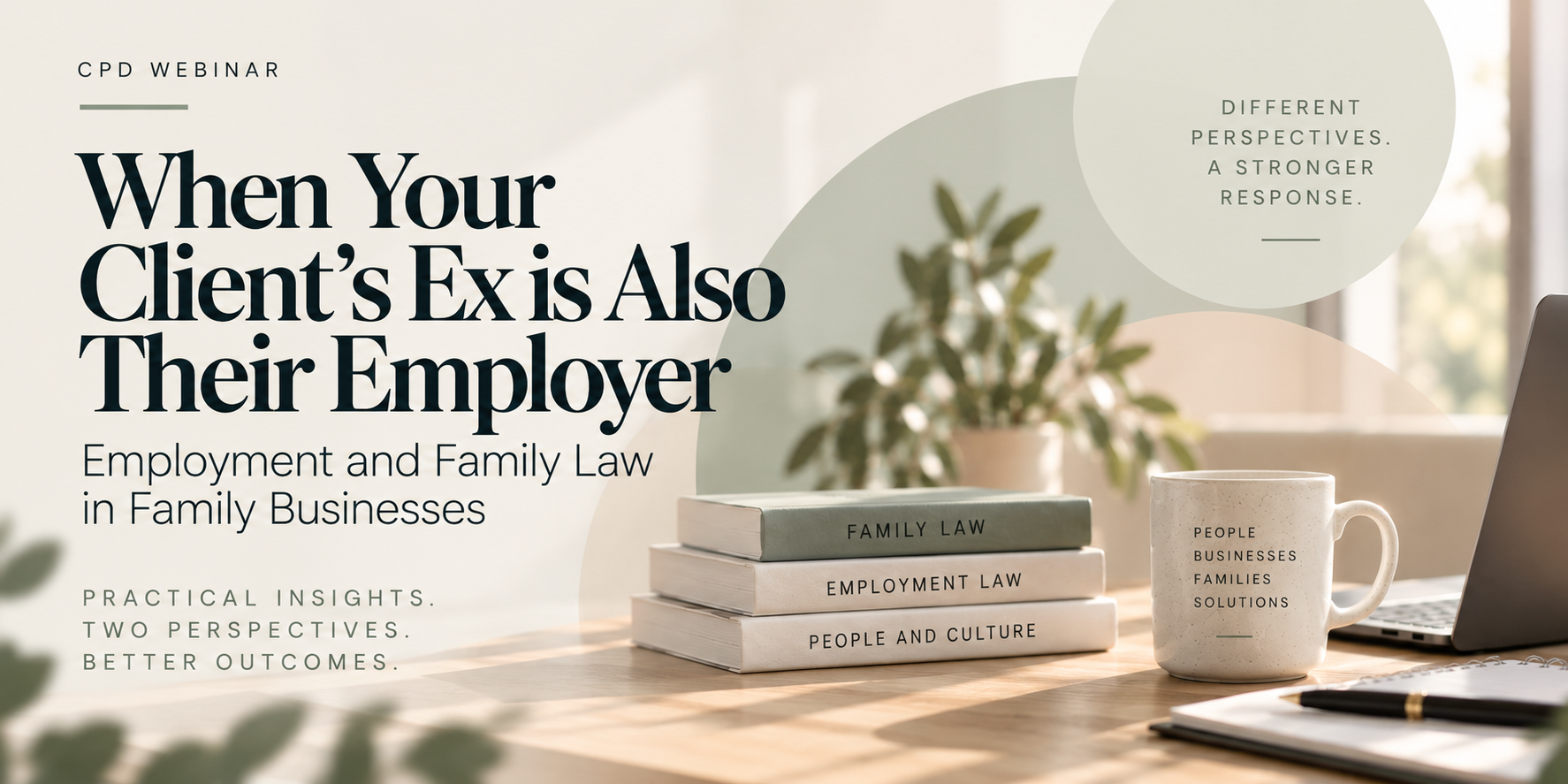
When Your Client's Ex is Also Their Employer brings the two areas of practice together.
Presented by Ashleigh Morris, family law barrister, and Louise Miller, family lawyer with an extensive background in employment law and senior HR leadership, this practical CPD will examine what happens when separation, employment and ownership of a family business collide.
Rather than teaching employment law and family law in isolation, the session will work through the issues from both perspectives: what does the family lawyer see, what does the employment lawyer see, and what might be missed if the problem is considered through only one lens?
What we'll explore
When separation changes the employment relationship
What to look for when a client's role, remuneration, hours, access or employment suddenly changes following separation — and when those changes may raise issues beyond the family law proceedings.
Employee, owner, spouse — or all three?
Untangling the different capacities in which a person may be connected to a family business, and why identifying the legal basis of their employment and business interests matters.
When the income stops
The different family law and employment law considerations that can arise when a former partner who controls the business reduces remuneration or terminates the client's employment.
Employment rights that family lawyers should recognise
Identifying potential employment entitlements, claims and remedies — and knowing when the client may need separate employment law advice.
The evidence hiding in the employment relationship
Employment contracts, payroll records, remuneration history, leave and other entitlements, company systems and workplace communications can tell a much broader story about the parties' financial arrangements and roles within a business.
The family law response
How employment developments may interact with questions of disclosure, interim financial arrangements, maintenance, property division, business interests and the conduct of family law proceedings.
Strategy when two legal frameworks apply
When should an issue be pursued through the family law matter? When might an employment law response be available? And what should practitioners consider when action in one jurisdiction could affect strategy in another?
One problem. Two legal perspectives.
At the centre of the session will be a practical family-business scenario that develops as the webinar progresses.
A separating couple operates a business. One party controls the company. The other works in it and depends upon it for their income.
Then things begin to change.
Access is restricted. Remuneration changes. Employment ends. Entitlements are disputed. Business records become important. And decisions need to be made about what to do — and where to do it.
At each stage, we'll consider the problem from both perspectives:
What should the family lawyer be thinking about?
What might an employment lawyer identify that the family lawyer could otherwise miss?
Who should attend?
This session is particularly relevant to:
family lawyers;
employment and workplace relations lawyers;
barristers practising in either jurisdiction; and
practitioners advising clients with interests or employment within family-owned businesses.
No prior employment law expertise is required.
Why attend?
When a client's former partner is also their employer, the loss of a job may be much more than an income issue — and a family law solution may not be the only solution available.
Family lawyers do not need to become employment lawyers. But they do need to recognise when the facts sitting in front of them engage another area of law.
Likewise, an employment dispute arising in the middle of a separation cannot always be understood without appreciating the family law proceedings happening around it.
This practical CPD is designed to help practitioners spot the crossover, ask better questions and recognise when another area of expertise needs to be brought into the matter.
Presenters
Ashleigh Morris — Family Law Barrister, Victorian Bar
Ashleigh practises principally in family law, appearing nationally in high-conflict parenting and complex property proceedings in the Federal Circuit and Family Court of Australia.
Louise Miller — Principal, Veritas Family Law
Louise is a family lawyer and sole practitioner with extensive prior experience in employment law and human resources. Her combined experience provides a practical perspective on the employment issues that can emerge when personal relationships, working relationships and family businesses intersect.
CPD: 1 point*
Format: Live online webinar
*CPD eligibility and allocation are subject to the requirements applicable in each Australian jurisdiction.
CPD information
1 provider-stated CPD point · Confirmed
CPD eligibility varies by jurisdiction. Confirm allocation and category with the provider before relying on it.
Practice areas